

◆
A job, not a request
A worker starts with a clear outcome, not a one-off instruction.
Deploy a specialist that handles the whole job — not a chatbot you prompt step by step.
The gap
A general model can write, reason and code. But it doesn't know your domain, your context, or the standard the work is held to. The missing layer isn't intelligence — it's expertise.
Generates responses — but often lacks depth.
What a worker is
A prompt gives instructions. A worker knows the goal, follows the process, uses the right tools, and knows when to ask for help.
A worker starts with a clear outcome, not a one-off instruction.
It knows what it's allowed to do — and what needs a human.
It follows the steps an expert would take, not a single guess.
It's measured on the work it's built to do, before it ships.
How Lancis works
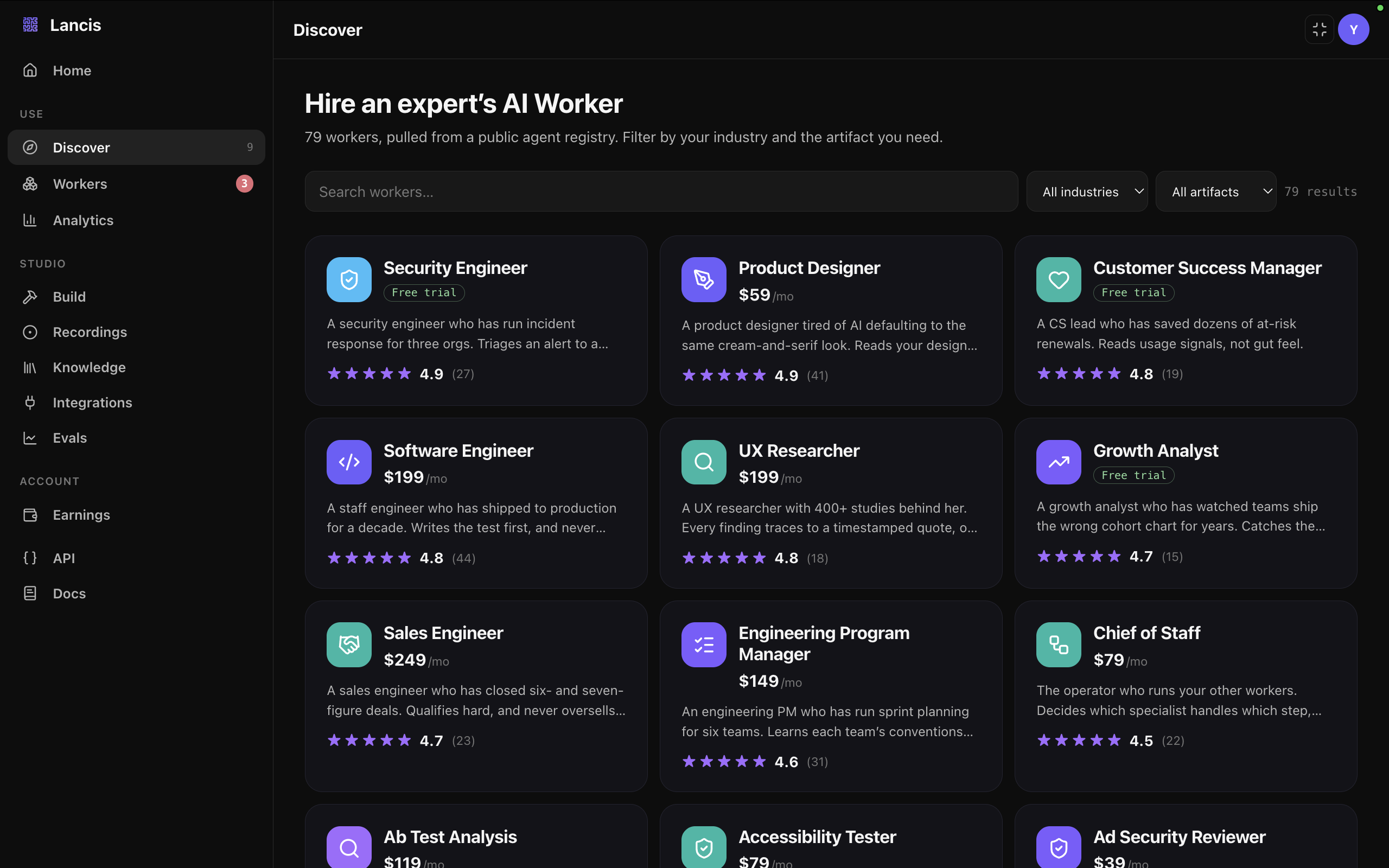
Browse workers built by domain experts — each with its own conventions, an eval that proves it, and a price. Deploy the one that fits your workflow.
Model-agnostic by design. Each step runs on whichever model you pick, on your keys — and the worker deploys into the tools you already use. No lock-in.
 Claude
 Cursor
 Codex
10+ open-source models
Codex
10+ open-source models
You see every step it takes, and anything past its guardrails routes to you — it proposes, you approve. Oversight, not autopilot.
The shift
The next generation of companies will not only buy software. They will access specialized intelligence.
Two sides
Every expert has workflows that can't be easily automated. Lancis turns them into reusable AI capabilities.
For AI creators
Show Lancis how you work, and it becomes a worker companies can deploy — one you own, that pays you when it's used.
For companies
Deploy a specialist for the job instead of building AI in-house — and see the eval before it touches production.
Browse workers built by real experts, or turn your own expertise into one. Every worker ships with its workflow, guardrails and an eval that proves it works.